
50% rounds end before the 2x multiplier. Most Aviator players discover this figure after several sessions, not before. And it is this statistical reality that should guide every cashout decision in Spribe's crash game.
Aviator runs without levels, without boxes, without numbered steps. Just a curve that climbs and a button to cash out. Since 2019, this mechanic attracts because it seems clear-cut. However, the pace of the game hides subtleties that many players do not perceive at first glance. The rhythm of the rounds, the distribution of crashes, the timing of cashouts: everything revolves around a very precise tempo. Understanding this tempo radically changes the management of one's sessions.
The mechanics of Aviator compared to step-based games
Pilot Chicken, Chicken Road: these games break down progression into steps. You pass a box, think, move forward. Each level offers a visual and mental breather.
Aviator operates on a different principle. The curve rises from 1.01x without interruption until the crash. No intermediate box, no visual reference between two thresholds. The multiplier climbs in real-time and the player accompanies this movement with a single tool: the cashout button.
The consequence on decision-making is direct:
- Step-based game: you choose at each step, with a natural pause moment
- Aviator: the decision remains open at all times, until the moment you press
Aviator generates continuous tension. You do not select a level to stop. You choose a precise moment to leave a curve that waits for no one.
| Setting | Value |
|---|---|
| Publisher | Spribe |
| Exit | 2019 |
| RTP | 97% |
| Volatility | Low/Medium |
| Min/Max bet | 0,10 € / 100 € |
| Max win per bet | 10 000 $ |
| Double bet | Yes |
| Auto cashout | Yes |
Rhythm of Aviator: the actual pace of a round
A round of Aviator lasts between 20 and 90 seconds depending on the height reached by the curve. It seems short. What matters is the density of these seconds.
Here’s how a round breaks down:
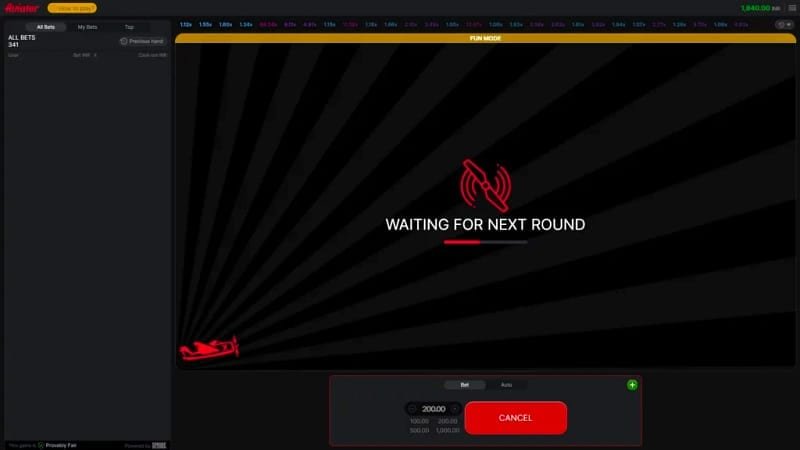
- Betting window (about 5 seconds): the player places their bet before the curve starts
- Flight phase : the curve rises, the multiplier increases
- The crash : instantaneous, with no prior signal
Between two rounds, a few seconds of pause. In an hour of active play, count 50 to 80 rounds if you play continuously.
This tempo produces a concrete effect: decisions come quickly. A classic slot offers a 3-second animation that marks the result and provides a moment of breathing. Aviator chains rounds without this buffer. A player who does not structure their session may lose track of time and the number of bets placed.
Distribution of crashes in Aviator: the numbers to know
The RTP of Aviator is set at 97%. But this figure does not indicate at what multiplier the rounds most often stop. This is where the mechanics of the game make sense.
For a similar concept, see our Spinhub casino payments test.
We also tested CCTV Rush Hour no download, which operates on a similar principle.
Crashes follow an exponential law. In practice:
- About 50% of rounds stop before 2x
- About 25% of rounds end between 2x and 5x
- Rounds beyond 10x remain in the minority
- Very long rounds (50x, 100x or more) exist but are rare
In practice: the majority of rounds are short and conclude in a few seconds. Systematically aiming for high multipliers means seeing the curve stop before its target in most cases. Not a game bias, simply the mathematical distribution.
Reading the rhythm of Aviator involves accepting this fact: short rounds are the norm, long rounds are the exception. Setting your target cashout based on this reality is the starting point for rational management.
Real-time cashout: read the Aviator curve without anticipating it
The cashout button becomes active from 1.01x. You can exit at any moment during the flight, at 1.5x as well as at 300x.
This total freedom is the strength of the game, but also its difficulty. Every second of waiting corresponds to a slightly higher multiplier. Every second of waiting is also one second more before a potential crash.
Unlike a step-based game (I either pass or I don’t), the cashout decision in Aviator works like a continuous slider, in real-time, without a natural stopping point.
What experienced players observe:
- Exiting at 2x is more difficult than it seems, because the curve continues to rise
- No visual signal confirms that «now is the right time»
- The crash occurs without warning
Many players who master the rhythm of Aviator set their target before the round begins and stick to it. It’s easier said than done, but it remains the most effective method for managing the pressure of the moment.

Aviator auto cashout: from rhythm to discipline
The auto cashout allows you to set a target multiplier before the round. If the curve reaches this threshold, the game automatically cashes out.
It removes the real-time decision from the equation. It’s not a guarantee of winning: if the curve crashes before the defined threshold, the bet is lost just like in manual mode. But the auto cashout solves the problem of hesitation and late cashout.
How some players use it:
| Mode of use | Typical threshold | Logic |
|---|---|---|
| Conservative sessions | 1.5x to 2x | Frequent exits, small margins |
| Balanced sessions | 2x to 4x | Mix of standard exits and long rounds |
| More ambitious sessions | 5x and beyond | Fewer exits, larger gains if the round allows |
With auto cashout, the pace of play changes: instead of reacting to every movement of the curve, we let the rounds run on a fixed parameter. Some players find that it reduces pressure. Others prefer to stay manual to maintain control over each round.
Double bet and session pace on Aviator
Aviator allows two simultaneous bets per round. Each bet has its own cashout: one in auto, the other in manual if needed.
This option changes the way each round is experienced. Instead of a single decision, the player manages two sliders:
- First bet set on a low auto cashout (quick securing)
- Second bet left open longer, if the round allows
The principle: not to lose everything on a short round while keeping part exposed to a higher multiplier. It does not change the probabilities (each bet follows the same statistical rules), but it distributes risk management over two separate decisions.
What French players say
Mathieu L., Lyon, March 2026 – 4.7/5 «I had played step-based games before Aviator. The difference in feeling is clear: here, there is no ‘box’ to pass, the curve goes up and that's it. At first, I found it difficult to know when to cash out. With the auto cashout at 2x for most of my rounds, I found a rhythm that suits me. The demo mode helped me understand the distribution before playing with real money.»
Clara D., Bordeaux, March 2026 – 4.6/5 «What struck me was the speed of the rounds. 30 seconds is very short. In my first session, I didn't realize how many rounds I had played. Since then, I set a maximum number of rounds per session, not just a budget. It changes the way I manage the pace.»
Romain F., Nantes, February 2026 – 4.8/5 «The double bet took me a while to adopt. But ultimately, it's what allows me to stay calm: one bet cashes out quickly automatically, the other I let run. In long rounds, the second one compensates significantly. And in short rounds, I still got something back with the first one.»
Strengths and limits of Aviator
What works:
- Simple mechanics to understand in a few rounds
- RTP of 97%, among the highest in casino games
- Demo mode without registration to calibrate your approach
- Auto cashout and double bet to customize management
- Short rounds: an intense session doesn't necessarily require a lot of time
What you need to know before playing:
- The fast pace can lead to placing bets without realizing it
- The curve gives no signal before the crash
- About half of the rounds crash before 2x: aiming for high multipliers constantly exposes you to many round endings
- No strategy guarantees a positive result, the certified RNG ensures that each round is independent
Responsible gaming
Aviator is a game of chance. Its rounds come quickly, and this is a factor to integrate into session management. Setting a time limit and a budget before starting, then sticking to it even if an encouraging series makes you want to continue: that's a reasoned approach.
If you have questions about your gaming habits, the service Players Info Service is available at 09 74 75 13 13 (non-premium number, 7 days a week, 8 AM - 2 AM).
18+. Playing involves risks. Play responsibly.